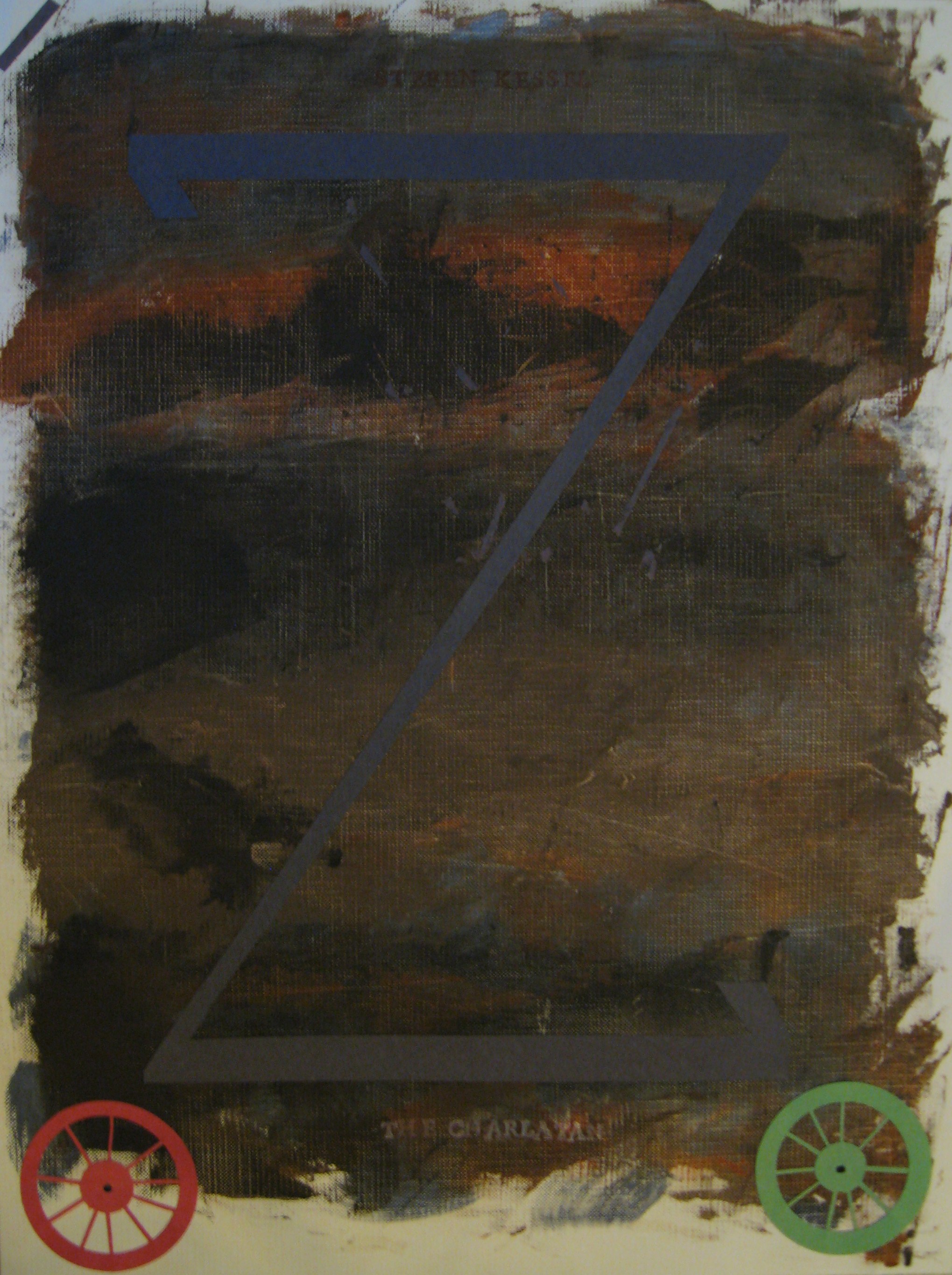
The Charlatan
by
Stefen Kessel
ex nihilo nihil fit (moved to seance project)
In the beginning, all was night – no meaning, no signs – only an unfortunate, tranquil slumber which knows no strangers. But one ominous evening, it seemed as though something were floundering in the orderliness of his presence – stern and whole. Something which, despite all its endeavors, was unable to crawl out of the one quivering body even though one appeared to be larger than the other.
Precursory Symptoms
“‘I am double…’ That is the thought which always keeps me up.”
This may seem a strange way to introduce a man presumably of the imagination not quite ever known on earth by the name of Von Kriege and who so willingly departed from cooperating in efforts to deliver him to the literal hereafter. Seldom did its author enter into negotiations with the matter-of-fact novel based upon things actually seen or heard or heard of. He understood and insisted that no logic should be quite as important to the narrative as the implacable flow of the word.
The hope, then, of reporting a minutely detailed picture of one man’s brooding life in the manner of a respecter of facts is something I simply can’t consent to. If any reader reading this living autobiography of him—a modest space where he lived word for word for many years, a suitably melancholy tragedy—should eventually seed the door of indifferent hope, the door where some see the error of their way when sorrow overtakes them, the door from which he emerged and where they now entered, more attentive than usual, walking sister and brother as into two glass panes, reading along in a more generous spirit than the customary passer-by, then the pleasures and cares of the world will take root as in the seductive quality of a summer evening.
But the book is much more: the weight of sin meditated on, a rebellion by which he would rid himself of the other. In this way, the words are printed and disappear.
The Hunter in the Forest
The scene: the boundless universe
—a comedy immense—
In acts unnumbered, a house was built by human nature, fresh from the hand of poetry.
In a few words, it was nowhere. But from time to time, it found its way back to the primeval history preserved for us in the remotest antiquity.
Some mental machinery shuts the door, pulls in the latch-string and is wholly at home in that immortality of the universal storehouse of the everlastingly forgotten, the great unutterable drama.
Now suppose—wishing to bring back the sound of that deaf unknown elsewhere under a somewhat different form of that well-known magic—we take a man whose poetry the world knows not and toss him into the focus of civilization. Those two very ancient fables—without any principle or connection—writings of the best species of literature, scattered under the embalmed truth, flourishing among that whole being we have already mentioned which seems to have written nothing itself—nothing but was remembered—contained in speeches which fall from the lips—a few scattered fragments that may have come down to us—but was long forgotten.
Speech and reason—the intercourse of these beings in all their parts and forms had no employment but, mingling with itself, the first rude passage from mouth to mouth blossomed and ripened—created and endowed the elements themselves—air, earth and water—invented, by the force of its own genius power and compactness, noble narratives introduced as profane history—a chronicle of the realities, as well as moral truth, of man developed by time.
This disputed subject must be left to those who have a taste for inquiries into such creatures as extended romances or dramas. Certain it is, however, that this system wrought at the same instant a not improbable sentence of condemnation upon itself and, bearing the almost unrivalled exquisite elegance of the rules of arithmetic, such a distinctly deformed exterior of playful fictions of the life of man as to successfully conceal itself within that very current of mere amusement that soon became the most important occasion and revealed the difficult problems of human conduct.
All the graces of style are sufficient to show that their author possessed the constantly remembered need and desire to remain forgotten—though burdened unremittingly, desperately with the insufferable seat of the empire. Be it no surprise, then, this poet should one day unexpectedly but entirely become a mighty hunter taken up into a forest, horribly roaring like a beast of tremendous size, so saying:
Let me taste the twisted pains of men. I will devour death in the agonies of these books so their pleasures come to be translated in the same manner—into the ancient language of this country and expressly for that purpose. I am the fountain of word unheard, I am the ornament and machinery of the hand of God, I am the innumerable birth—a thousand and one imitations, mutations, modifications, translations. I am fain to gravity’s reign, and I sustain and supply virtue’s vice. I cheat sleep where fable slept, and there, I became other things. I return not finding any. The result is before you, my imperfect knowledge—the heartfelt and hungry-looking stranger who knocked at your door, the hatchet-tongued stranger not given name but expressed in the so-long-neglected task. I am unadorned and disconnected.
I am a man of war.
Two jackals (you might say, thieves) that figure in the histories came to be mistaken, either directly or indirectly, for their author. This remarkable book passed down the stream of time, version after version, till it slept in the dark ages—the mistaken loss to which it gave birth and over which it undoubtedly had great influence. A translation was made in succeeding ages—though it may not fully sustain the existence of the world, speak it anyway with reverence:
I wounded him—the poet—so that he fell.
I cite the verse—for a whole day, one month.
I devour his hunger—this flesh not yet tender.
I am a man of war—the remainder is thine own wealth.The hunter, the word and the forest—all three dead.
The Upstairs Room
It is unusual to burden a novel with living people telling a story of people you would know were marching into darkness. But few will know and the meaning is a long way off. If I were telling a story which I believe you would know, if you are to experience anticipation and self-recognition, you would know the special compassion that these people’s past is your future: you might have been one of them, you might be one of those people marching into darkness. Perhaps this had better be explained.
So, the house cracked. The world cracked, and the words were running together with the people, burning, shooting, stabbing, strangling. No one knew—they refused to understand, did not allow themselves to feel of the environment, circumstance, and emotion. The signs and the instruments hid their fears and faith, trust and goodwill. Seeing much, yet not seeing nothing.
Two knew—there was a true bond, deeply woven into a new pattern in an upstairs room, secure, cut off. It was planned—yet no one knows exactly how or by whom—two working in secret, cloudy rumors, seeing profit in chaos—the melancholy planners of a demoniacal history of nothing in the flaming midnight ecstasy of barbarism. These two who held the key, who believed the gods were bent on destroying them and their way of life, who chose to pass through the nights in the fields of war forged on nothing short of love. There was love, and there was everything else: the bodies of women, children, men, the victims of an appalling punishment caused by that great machine of mass murder and history’s cruelest example of hatred: power. These two fugitives sprang up in a mutiny of outrage to answer power with love and mass murder with a fury of murder nothing remotely like it.
This story is my mutiny, and this book is a work of fiction (the one or the other), an explosion set off by the last incident. Drawn from reports, letters, facts, fictions, my object has been to make the fictional whole present a true perspective of fact—the facts greased with a mixture of pigs’ fat and cows’ fat. If your interest in the mutiny is aroused you will find that any history of nothing is exciting reading; but look to see whether a charlatan or money broker wrote it, and make allowances accordingly.
As a general guide: places actually visited and persons actually met in the story are fictitious; people and places that remain offstage are or were real. Where I have enlarged upon fact, I have tried to use the precise pronunciation of words to make its meaning clear. In the context of history and tradition, all these preparations and portents could not be hidden from the religious and superstitious wondering in terror what to do and regarding with scrutiny the decaying brick, the sarcastic sun growing noticeably worse as the years pass, a swirl of fish up through the branches, thousands of feet above the city, scavenging the black dots pockmarking the sky, two kites twinkled and stirred in slow circles in a cascade of scarlet and gold sparks. With a creak of wings, a crow landed on a nearby plinth—no other bird anywhere. Its eyes glinted with an awful obedience. The air and the silence crawled on top of one another swelling out and taking shape. The crow hopped forward closer and cocked its head. Now the leaves began to sweat and shiver and back off. Its eyes, sharp and brown, looked quickly around and turned down on the river over the heads of the crowd. His influence was enormous and widespread, and he might explain what he knew with proprietary pride.
Was catastrophe in the air, in the puddled road? The black vision of the crow shone coldly on the people. “Many have come. Are you all, then, the ghosts of dead tyrants? . . . You? . . . And you?”
The crowd breathed hard and burst into struggle. At the limit, a gardener said, “I don’t understand.”
The crow laughed harshly and snapped, “There are many things you do not understand. It’s like going out to sea in a little boat. There are the great dark waves in the misty fields of the open ocean ahead with the sun shining on the fleeting edges of magic. You must have noticed it.”
The gardener did not speak but shivered off invisible shackles and held silvered hands out to the crow.
“Look,” said the crow, “there’s the city on the land, but we’re not in little boats. The fishing boats are anchored in the harbor.”
“I will find out,” replied the gardener as tears stumbled from his face.
The crow saluted through half-closed eyes, tossed his head and flew away.
As it turned in under the bare branches of a distant gold mohur tree, the gardener listened to the hurrying echo as it faded down the stairway of compassion.
An American Tragedy
Dusk—of a summer night.
It was hot with right angles all about it, and a most unimportant-looking person, who carried a small book such as in time may linger as a mere fable—but not too enthusiastically—, was constantly thinking of how he might better himself. The energy was in town again unconscious of anything save a purpose to make its way between the contending lines which flowed by comparatively hushed but solid and vigorous—an independently portable progress amid swiftly moving streams obediently following the tall walls of the commercial heart of the city—now quite bare of life of any kind—just a wide flat thoroughfare, the product of an environment with no guiding or mental insight.
It had been obvious to people that the history of this man (one or an other) is of no particular interest yet with a sweet languor about which clanged the bells of a somewhat peculiar, different, and highly emotional not-yet-home. He brought a more vivid and intelligent imagination to things, but with scarcely any truer or more practical insight into anything. Those anomalies would be hard to make clear in the eyes of others, and were so poorly integrated and correlated that the calling of his psychic and social responses appeared, as has been indicated, to unravel.
Yet that did not deter him. He was glad enough to go and say nothing. He felt that he had a right to do something for himself—a form of diversion he had to conceal from the face of fortune—and, in opposition, he felt himself occasionally rich—though very much belated in the race and being not much worldly.
He was a newcomer who had written a book of great promise, a printed statement offering the last scenes of all this impossible story destined for an early and profoundly commonplace death—something like a polite inquiry wandering out of the house purported to be an answer that can only be questioned by time. I believe I have even seen the front steps of this house. One day there was a loud knocking at the door later translated by one of the two present. The visitor shortly introduced himself somewhat directly. It was, as I have said, a memorable event, and I suspect it offers a picture of who is telling the story of the present volume. To be sure, in the second book, he becomes the story that was written in the first.
His method of work was not unlike that of a man in a dream—he performed inhuman barbarities upon the word folding and refolding them upon a library of counter-words, committing murder as a sort of nihilist accident that casts the essentially irremediable agonies of mankind against the attempted reestablishment of the adamantine presence of an ever-dimming silence the traces of which, though suffering from what he himself described as the secular suffocation of facts (not infrequently increased by clichés) generally believed to be directly observed, remained faintly within the dying embraces of that text escaped as much from the luxurious, pretentious apartment in the swanky suburb as from the slum. That text, in truth, was extraordinarily free from its source, whatever it made him for a time. Where he picked it up I do not know: perhaps he invented it himself.
He would produce 400 words—the stuff poured out of books almost automatically—by mid-afternoon. Then he would go for a walk, usually alone.
His house (the author’s incapable of inventing a better word) is all over. It is a commentary upon human life in general.
In the days when the story was written, the reading public was surely not over-close due to the sheer bulk of American letters, so many critics and persuasive reporters who monopolize the conversation, and a hard to imagine menagerie of publishers and pirates on the high seas, predominantly hopeless content royalists.
(198)
He found himself ambling on and on… he must return but which house? what street?
sister in whom he took no little interest, unexplained meaning of it all, revealed truth, chemism of dreams, secrets a-whispering, invisible ray
(301 – loose page – “she bent and whispered in his ear, “Is this it, the mystery?” plus Amer Trag 29-31)
Toward the discovery of the Mother
Returning to the room, he was before it all the time—minute to minute, hour to hour. Look in his eyes. Oh, how terrible! The mingled pain, unrest, dissatisfaction—a dizzying sensation. His dark eyes could not see that upwelling force of life and love, the wonder and delight of a new and more intimate form. The hours dragged until, finally, a piece of paper found on the floor there—he opened it and read in the spirit of one who is in agonized search for the night concealing for the time being the long day that might end—nights dreamed and nights yielded to the other completely, from day to day yielding to the approaching night come what might and not without a sense of evil, a wild convulsive motivating pleasure—by day being abandoned in the night returning, so completely overcome—feeling for the first time this sudden abandonment as plainly as any words—peering nervously into the sacred precincts of the blank future in the silence of this unlighted room he might never know again—he hurrying to meet somewhere one who was truly beginning to know—and so taking to himself one who knows something about life—less loyal to the seducer, the chief ambitions of men—veering instead to say nothing—despite various failures and only later proving again that he was either unsuccessful or ill-fated, helpless at having struggled in vain against the greater intimacy of that other and desirous of yielding to it, painfully convinced of it, looked forward to approaching the middle desert of that night so wild and unrecapturable to an individual, a man of the world—obviously willing to sacrifice himself in whatever fashion had hitherto characterized him. Must there not be others?
Still, he looked at himself in his mirror from time to time and recognized himself. The one thing that did trouble him at times was the thought that possibly he had never possessed the proper notion of life.
And therefore, in his rather neglected state, he was content to devote himself to much of what time forgot: that great house, closed and silent, except for an occasional gardener visible from time to time. At the same time, he did not speculate too deeply as to all they represented—something might go wrong, the symbol might prove embarrassing. If fortune would but favor him a little, these pleasures, at full tide—as in a dream, really—expressed to him a dark secret, an ecstatic paradise of sorts in the abandoned center of a humdrum conventional and petty and underpaid work-a-day world.
Yet so far as the beauty of the various houses were concerned, he had never quite been able to expel from his mind the thought that his future must in some way be identified with the gardener that was here in the precious and unusual and intriguing movement and life so much in evidence. Oh, if he were but of it!
Birth of the Menaced Assassin
I cannot and will not wait and suffer one more hour. I regret to have allowed all this time to be compelled by the world, cowering my whole life to what society would think and do. My whole life is ruined, but I feel that I am entirely to blame.
But I will not wait and suffer one hour more. I have done now all I possibly could to go in silence, to really be possible, to take this step. I hear you, I shall be in that night, to insist there must be more secrecy. Get ready. Think now quickly and then act. Do not fear! Do not be weak!
And if necessary strike a light blow, so as to stun her so that falling in the water, she will drown the more easily.
Walk through the woods by night, not by day—so that when seen again it will look as though you had gone elsewhere—not elsewhere after you return, but before—should you be sought, go to some little hotel somewhere with a view of the snow-covered mountains and a gramophone that decides to skip at just the right moment.
Pack all of your things in your trunk here, but leave it in the nearest quiet corner, in the event that anything goes wrong, you can return here to retrieve it and depart.
Use a false name and alter your handwriting as much as possible. Assume that you will be successful.
And whisper, whisper . . . let your language be soft, loving, even. It must be, if you are to be your own darker self.
And with this, he was finally ready. He was leaving once and for all, numbed by the fact that now decidedly he must act. He must bring himself to the place where he could be one or the other—to say the necessary something that he could not write—one or the other.
Could it not happen? With nothing, offering all? With everything, asking all?
In present indifference, he now went in those silent halls where they were trying to keep everything so secret.
He felt that he could do anything—drown her easily enough. But with his help she might still save both of them.
And so it was that he now stepped forth in order to see himself. But now seeing him actually present, a heavy shadow that was lurking in the corners lifted its dark and tortured eyes. He must not let fear influence him to anything less than he had now planned.
“You see I am here.”
And at last he had come.
A strange pair of dice
I walked slowly through the pine woods back to the house. I crept silently up to the room full of secrets.
I sat down somewhere near her dead silence. There was no wind, there was nothing – just the house which now seemed unnaturally large and quiet.
I made up a story to explain my own breathing and the reason my heart was beating. She was watching me with an indifference which went more than skin-deep. For some reason this assumed a vital importance when suddenly she asked:
“What’s the matter? What about that essay you’re writing on Pascal? I don’t see it anywhere.”
I had been talking about Pascal, implying that I was working on a certain passage, but I had not written a word. In fact, I did nothing. I was working hard at staring at myself in the mirror.
“Haven’t you anything new to say to me yet?” she asked.
“Of course not!” I replied.
The silence looked at me. I felt it grow in me, it stretched out and even raised her voice at me going on about marrying me and how we would be together always – but in that brutal, detached manner. I was not so sure it was love I felt for her, and I have no wish to delude myself on this point, but just then – the silence murmuring from the middle of the room – I loved her more than I loved myself.
And the tension was unbearable. I had no idea what she had done until I tried to leave the room to get a glass of water. I went to open the door, and was surprised to find that I could not get out.
Gradually, I became quite calm, tried to collect my thoughts. But thought was as unbearable as the vast emptiness around me. Sometimes I find myself groping for that strange moment when my hands no longer belong to me.
I knew my words would lead nowhere because I understood very well the horror of explanations.
“You mustn’t look at it that way. You wouldn’t go away and leave me so soon?”
Her choice of words surprised me. There was evidently still hope for some room instead of the other way round.
It was just as hard for her to make allowances for my shortcomings as to try to remove them. There was no escape; therefore, she was annoyed with herself and let me see it. It would have been easy enough for her to make me talk, but finally she let me go just as if she had been a stranger.
The incident I have just described was not without its pleasure, its shame, its fatigue. Perhaps the incident was symbolic.
In a month or two I would not be able to forget the greater depth that bloomed inside my body. Neither bored nor depressed, I could not bear the thought of the night, all the long night, without the caresses of dream to bruise me most passionately, the living silence, neither dull nor gloomy, took me in her arms as if searching for the means of attaching herself to me. I felt gay and carefree and I was surprised to find that I did not want to leave her for a single moment.
But I could not stay as it was getting late. The next morning I listened in the pine woods as we had planned with a mixture of fear and admiration.
“We’ll have to go even further than I mentioned, give up our old way of life altogether!”
“Oh, I suppose so,” I replied.
Atopos
Chaos is a work of fiction.
Beyond the sounds of traffic, the chimneys, the painted walls, a gray slate roof, beyond the branches of hardwood trees: the nothing I’ve never seen stirring in the stagnant, apocalyptic chasm.
Were it not for the vapor trails I ride, I might refuse to believe in this vast void of unpredictability – its ancient anarchy bordering brick and building, yard and twilight on such a pedestrian campus.
Deserted in the hot shade on this earth, I’m the only witness . . .
Except maybe if I take a walk around the scary basement no one wants to enter or acknowledge, if I share a play on words in the dark side, explanations for God’s punishment. As long as I’m not expected to repeat provocative stories that are always believed in this part of the world – certainly not the ones I constantly hear. Dorothy says that I have to be entertaining and maybe she isn’t my real sister. I shouldn’t need to explain myself at all, but my day begins in the background where death remains unbroken in a goblet of blizzards as I’ve heard it described.
Apparently, Honesty is stealing vast amounts of the hopeless night and rearranging her furniture in the hope she’ll lose her photographic memory. I’m used to hearing every word of it in my head – the most dreadful slogans that end up on the coffee cups of an auditorium full of jaded policy makers, the thieving global leaders of tomorrow.
But the cops are calling on me – getting me out of bed – advising me that the more insensitive the job, the more necessary I am.
It’s a gift and a curse in this imperfect world of twilight and the science of catastrophe.
All the while . . . left to my own devices in his workshop.
Remark: In reading poetry, do not sing it, but emphasize it like a void.
The Human Potential

What can we say with our higher learning?
            That outer bark of the brain cortex?

What can we say?

Today we will be “wrong” about tomorrow.
In a sense, we might say: today we will be “wrong” about today.
And what about tomorrow?

What can we say?

Whenever these big-city supermen talk of their
                     run-of-the-mill expectations,
                     the scant lives they have lived,
                     their hordes of housewives performing ordinary feats,
                     their children driving along freeways of rigid limitation,
                     their thought patterns well-established,
                     their practice of abstract reasoning commonly agreed-upon,
                     richly educated technicians, researchers, jet pilots -
                     quelled individuals - deprived, mentally crippled,
                     robbed already of the potential miraculous wonder.
                     Is there any worse crime?

What can we say?

                  What young daredevil within his lifetime
              will take one glimpse into that darkened room,
                -silent and isolated-         but not only that
                  who will find that          the size and weight of it
                            becomes larger and heavier
                       than anyone would have believed?
                             An important environment,
                    from this vantage point, that could enrich.

Already, it has come back to me many times, and in those days
                    I hear
                    I go
                    I find
                    I say

What can we say?

Today we will be “wrong” about tomorrow.
And what about tomorrow?
Tomorrow we will be “wrong” about today.
And tomorrow we will be “wrong” about tomorrow.
And the darkened room becomes ever larger and heavier.

If so, is there any better crime?
In Exile (The Dummy Speaks)
All these fortuitous collisions – as fatal as the striking of a grandfather-clock which only appeared to superimpose itself upon the unseen silence, the irrefutable signs of its melancholy echoed in some inexplicable way in the flesh, a mysterious series of messages in code transmitted by unconscious links.
In the mirror I always see the image of an ageing animal whose delusions multiplied themselves beyond the bounds of endurance, terrifying landscapes and faces burning into extraordinary shapes, personalities with distinguishing names engraved in stone – this could be proved by relighting them over and over again – to verify his findings in his own records – to be sane by the standards of ordinary behavior – to pretend the logical and persuasive frame of causality was a real situation we all shared – to be purely acted out and very little more.
But he had the air of a man who wielded an axe of some enormous exotic strength and their common life was like a cable buried in the sand. Whether for himself or for the others, he recognized the chance to discover the impossible madness by plunging them both into the impenetrable darkness.
He knew, then, the noises in the room next door, the sudden playing of the Devastatio on three simultaneous pianos were not delusions but invitations to experiences I have never known.
Now the work renounced the power to repress itself. Still, there it was: the supernatural treatise lying withering in the window of a bookshop . . .
It was becoming harder and harder to pretend to be happy – or even real.
Reading aloud every long or little passage, the words repeated forever – and submitted to, obeyed – one more faulty judgement on a crumpled sheet to give one the illusion of watching the terrible nothing imprisoned, tortured, fought, and at last passed beyond.
The great becoming had to be decided at this time and at no other.
Riders
I ride some words – and you read the words that I ride. You might say that you are trapped by those words, stuck with their permanence. But the words that I ride upon might also lead you out of a trap or two – though words of that sort must inevitably form their very own trap. Herein lies the unsurprising revelatory event of endless potential freedom shaking hands with our inescapable prison-house.
A Dangerous Corner
Every human being is born with a gaping sore which admits infection. A sterile imagination sees only his own pleasures, his own difficulties through a particular set of spectacles – blind to the flowering of his inner self through the eyes of art and literature.
It needs more courage today to destroy personality, to destroy one’s habits which obey the suspect tendencies of the country, the newspapers which pollute the individual rhythm and instinct – it needs more courage to browse the old books and ancient formulas, to see with the eyes of the dead in the presence of nature.
What reply could one make to all this vaunted progress?
For a little village, a railway brings boundless enthusiasm, magnificent possibility and hope – but now that I am acquainted with life and men and our morally haunted history, I would like to have back my virginity.
The Silver Nightrunner
Shall I tell you a story? Shall I kiss it and make it better?
There’s the open ocean ahead, great dark waves hurrying away the echo of the last poetic words.
The murder was not spontaneous; it was planned by the state itself, that great engine of profit, whose history is a gloomy book of treachery, tyranny, and power. There was no love. But there was everything else. There were people settling into the new way of living, growing an awful obedience through half-closed eyes.
There was a man of war called the Silver Nightrunner: two people in one, a composite man, saying something and meaning something. His voice leaned over the edges of magic. He was chosen yet no one knows exactly how or by whom. He worked in secret through the nights, but he was direct and honest – committed to silence, presence.
The crowd that crawled on top of one another scavenging and tugging said: “I don’t understand.” The crowd breathed hard and fought. They refused to understand, believed nothing as a general guide and, having hid their fears, wondering in terror what to do, burst into struggle burning, shooting, stabbing, strangling.
In an upstairs room, secure, cut off, the Nightrunner had no business to involve himself with officers, princes, or administrators. For a moment, his imagination raced happily. At least he’d have the secret book – that would be his hut. He would just be doing his tormented duty gathering sparks.
Four hundred plus four hundred plus four hundred plus . . . it went on forever, as the sun was setting.
It would all vanish under the constraint the people would put on him, on one another. He would soon receive an invitation to the hunt – the ancient and customary punishment of his crime. The sentence will be carried out forthwith.
A century or more ago it would have been different – there would have been real work for him to do. No matter. He couldn’t do it anyway. There was too much money in it, a well of corruption. The sparks would be a mere showpiece, expensive and useless. He shook his head. He could live in silence and retire in presence.
His black vision did not speak again but rode pale and silent.
There’s the open ocean ahead, great dark waves hurrying away the echo of the last poetic words:
“Woe be to them that set out with great strides homeward!”
Windlass
Deep in the peril of empty night, something heavy trembled – that flowing nothing that was the solution towards which we all had moved – the soughing strain of the great wings of a violin.
He would stand for a long time listening, waiting for an invitation into the room next door before the illusion vanished and settled on the notebook in which he was writing – always just beginning – his hands selecting names from some huge script which filled in reality itself. The phenomenal world had begun to play tricks on him with so much fact-filled inconsistency.
The stranger, always seated in the same corner of that house, turned to the mirror – to the figure who bore a strong yet distorted resemblance to himself – a cloud of teeth reflected in a shop-window smile – he gazed at it – my own stranger stared at me now – I pointed him to the wall listening for the least sound – the noise of suitcase-hasps being fastened with a snap and the breathing of someone who all of a sudden felt an overpowering intuition – a short-lived but triumphant relief – as if his heart was inhabited by a colony of foreign heartbeats being expelled in some indefinable way – the mechanical slither of wires being uncoiled into a large empty space that refused to be investigated but had become a battleground for the forces of good and evil.
When he recalled this memorable event, he smiled and tip-toed to the window in an attempt to see his assailant – it seemed to him it was an elderly man, gaunt and sharp-featured. He was, of course, unable to confirm this.
The stranger, seated at his desk in the corner of the house always intended for him – the music of his heart unfolding from his body – that flowing nothing scattered by his own hands into the unoccupied room next door.
A Dream Gone Awry
The house was the great redoubt protecting the inner secrets of the world’s creation and destruction. The idea that language is music may seem strange, but the symbols of creative thoughts are not things discovered in nature. Grammatical sequences can be exchanged in communication only because of a mutual agreement among participants. The rules for the order of words in a language are purely arbitrary and are not an inevitable consequence of cultural development.
When the structure finally fell, detectives stormed into the inner chambers to find a place both mystifying and intriguing. The upstairs room has been studied by observing its basic properties. New laws appear spontaneously and opposing forces vanish. A strange world of tiny scintillations governed by the same principles as the process of creating clouds – the same symmetries varied only in intensity.
He wondered if he had stumbled on the building blocks of a bridge from nowhere – light shining on an experiment placed beyond the photographed target – a scrupulously clean procedure of mutual annihilation – in other words, actual versatility in expression became an astonishing fulfillment of the dream to reach into the realm of inner space and apprehend a reality not accessible through our senses.
So accustomed are we to the knowledge of the great societies that we fail to appreciate the uniqueness of the very brink of human existence, the symbolized expression of the world beyond the human intellect. For some reason, the dream seems to have become entangled with the attempt to develop a true representation of physical reality – but the success of any system is dependent upon the manner in which we orient ourselves in time and space and which observable conditions we use as signs of order to be measured.
There can be no question as to the natural harmony of the upstairs room in the celestial city. The range of both was infinite.
Ecumene
Here I must say a word about my whole journey – nothing more or less – as it winds and squirms – a little follower of the slender curve of the universe in every direction.
I woke up one morning – the sleeper already born in the fresh and limitless air of a perfect poem – and the first thing when I drew the curtain of my berth and look’d out was the exhiliration of immense fields in the whole of this region all bright with a long stretch of new words – here even more than usual – bending, slanting, swinging – previously quite unknown and altogether in full bloom as we rumble swiftly over their strangely technical esthetic spirit – everywhere something of that entirely western sense of vastness – dots of houses at intervals in these great plains.
I could not help thinking as I travel here in my days and nights – without a trace or sight of the hundred millions of people advanc’d upon the world – of the far circle-line of the horizon – the clear, pure, cool, rarefied palisade, not very high, upon which to the virgin eye, we ride – but to my senses, we make the whole of this characteristic landscape – the calm, chiaroscuro twilight – the palpable coolness of evening a little further along these endless wilds – day after day marked out by fertile, grassy green, yellow stacks of hay – night after night well-wooded forests at sea silently unfolded. I know the standard claim, but I am not so sure. I ponder’d the thought this useless, teeming region I was in the midst of should in due time be stopp’d, giving it up for a bad job.
I laid down the book and found there an absence – how destruction stretches and grows! – others attribute the matter to the coming generations – destined to play the future as the most warlike on earth. Even the simplest statistics are cheap, forming a safe passage to the most natural zone of thought and feeling.
But by far the most important dream on the globe – the inexhaustible, indescribable land and its adjuncts which involve a big part of the question – this primitive region partially inhabited but far more lovely and peaceful in its unplough’d innocence, untouch’d, unbroken – may well be press’d upon, marked out by design. Some think there are here cosmical analogies that have play’d some such part in history, commerce, and political power. Others think the word literally is the Union – its unfrozen and unruly outlet with a capacity to feed the world.
Only the whole of this journey, with all its shows and varieties and tributaries, will remain with me, hued in the boundless sublime.
Ladder (Model #TL-P 6.54)
Morning again. And I was afraid.
I thought: when I open my eyes, there will be nothing there. That is the peculiarity here in this house. Nothing comes sliding in through the window like a fully formless presence in the room. The words frame a picture of dynamic events, the walls of the room enclose the words, and beyond the walls: a sea of black.
The room grows in size without any shape or purpose. The problem is that words appear in this room at regular intervals. I once read about a man who wrote here not entirely by choice.
I am writing this “for myself” as they say, a stack of pages on a corner of the desk. As far as I can determine, the pages have never been moved and none of the words have been read. There was just a silence more troubling than each of the rules I occasionally violate.
Written out here, these words now look quite superfluous – the very sense of the word ‘silence’, the physical surface of the ‘s’, the narrow vowel and second consonant until the whole world burst into the calm pool of the final syllable.
I wanted to work on a project but I felt myself useless. I sat at the window to daydream, stare out at the lawn and garden, wires stretched across an ordinary sky, a gray figure all too fully awake.
A black bird detached itself from one of the pages disappearing a second later into the melancholic distance.
In the end, even the silence finally blew off in the breeze.
Unconcealment
The man gets up from the desk. He’s done nothing but write as long as he’s been in that room – write and observe the sky dripping methodically from one Friday to the next from his usual safe distance. He thinks he’s done the same thing every time: freed his mind of all order – all the superfluous order and redundancy calmly cataloged in archives and completed with strict routines.
The man stands motionless – taking note of the intervals between the well-defined paths – focuses on the tear cut into what remains of the night. A smile flits across his face – dress rehearsals for a murder – check to make sure that no one was watching – and slip into the space behind all this telling – inside this house of interchangeable instructions he struggled to translate. It turned out this spacious clutter of time could only be demanding one thing: the task of always constructing himself, that false promise of a little extra truth unconcerned by the failure to return home.
Still, you never know, right?
You never know.
Perhaps the hardest part was the dawn – having to come face-to-face with another day. But it was necessary, of course – necessary and grisly. He walks towards the window, he pulls the curtains apart, just the narrowest of openings.
Let the sky fall if it must!
Removing all traces of mind and memory – eliminating every detail. His thoughts run to what he has done – all the things she begged him to do in the long hours.
Everything has turned out perfectly – the outcome of all his work is entirely satisfactory. If you’ve come up with a technique that seems to work, he thinks, there’s no point in changing it. And it’s always a good idea to assume the worst.
But, times change, and it was midnight as usual – the perfect moment.
He turns to the armoire remembering to put on his gloves – walks solmenly towards it, pulls the door open. He lifts the wooden base and reaches into the false bottom. He pulls out the key needed to polish off the job. In a certain sense, it was the easiest job to be completed. He had calmly cataloged his movements and activities discovering it didn’t much matter: the important thing was to make the aim of the life he led even more unpredictable. And he came to the decision that this was the perfect place to settle the matter. Every scrap of information must be methodically removed. Everything is no longer needed. Yet there it remained. Everything: always staying a little extra past its time. Even the television is still lingering on after one last sign. His fingerprints will be of no help to the cops if they have no prior records with which to compare them.
Now see him walk downstairs. Now see him walk into the garage. Watch him walk unhurriedly into the front yard along the driveway and beyond the front gate. See him come face-to-face with the official spectacle. It is a mere redundancy. He’s already done it three times. He’s done the same thing every time. A steady routine. Order, he thinks. First and foremost, order. All things have become superfluous.
But the most interesting part starts now. Leaving the property by the garden path, he has the key in hand, the instructions he found on the desk, dress rehearsals for a murder.
I confess to being afflicted by recurring bouts of Cacoethes scribendi, a most distracting disease of endless forms that is triggered in my person by a complusion to invent and, therefore, actualize as many as possible of the endless ways that language may express its own inability to express Being. I, riding amidst every known fact as Stirling’s own lost jockey, a trusted fisher/hunter who, quick as lightning, rose above shady heights to eclipse the sun princess whose noted memoirs reportedly finish: “Don’t forget me!”
On Lake Silvaplana (my sister vibrate?)
I am at the beginning. It seems I am always at the beginning, but I much preferred it this way.
How pleasant it was to be going somewhere for the first time, standing on a remote and beautiful path stretched out on idle thoughts. I cannot imagine a better mistress of the moment than the hidden sea of shadows and dust for which we had all been longing since time had readily consented to brutal boredom.
I cannot say I wanted to “be myself” for I knew at all costs I must choose myself. But I refused to be molded.
How infinitely charming those deserted streets now seemed – the streets where we used to be together, revolt together, love together – the streets of our former life as we drove home at dawn influenced, readjusted, remodeled line by incestuous line that gradually turn me into two – the gently swaying boat of lines I had only read for the first time – lines I had endured by reading myself into the next lines waiting for me down in the golden cove of irrelevance – the root of all things, the generative force of life. And something arose in me like a storm in a way that made me sit up and repeat the complete paragraph. I held my head in my hands. I looked at the words intently. I felt cold and impotent in the face of the will of the world.
Certainly she would be good to us, right? She would turn us into civilized, well-behaved and contented persons and we, reading, we would yield to her influence, her intelligence, her humor, her sweetness.
But what good did she really do me? She was much too efficient. She fitted me into the framework of her orderly plan of living – and how easily! She kept me from liking myself. I was hurt by the taste of her kisses. I despised and ridiculed myself. I went on thinking that she was a danger to me and that I must get rid of her. I was completely lost. I simply could not go on. In time, I should no longer even want to.
I did not open my mouth. I thought of nothing. Some might endow me with startling complexes such as a love (or a morbid passion) for absence. I was so ready to give up the freedom to think for myself, even to think wrongly or not at all, but the discovery that we were entirely at the world’s mercy made me irritable. Looking at her, I thought: you have betrayed me, abandoned me! I would have liked to be caressed, consoled, reconciled with myself. How desperate I was! I tried to make the words speak to me about everything silenced. And already I was sorry for her as if I were certain that I would conquer her.
But tears came into my eyes at the thought that I wouldn’t be able to resist her.
The daughter of our intercourse
There has been a slight unpleasantness.
I think she was the only person in the house.
I thought she might have written something but the fact is she never opens a book – she says writing is a waste of time – unless there’s a major event, an unfailing opinion expressed. Valuable business is the only thing that ever interests anybody down here says she.
Business! It has to be done, it’s part of the world but it bores me stiff.
I supposed I was not a major event. Yet if I had been, surely some guilty hand would have written two words, words dangerously leaning one against the other and disturbed the others that slid after them, the others who had hitherto stood alone but now swayed and fell to the ground and broke into fragments like ornamental china, pieces I then swept up into my hand.
I arranged them in a row on the top of the desk – little sentences – meaningless little things, stupid in themselves but they were there for us to see, to hear, to feel – they wanted us to be together – in dreams, in words.
But I could not help it if I felt like a guest. The words had shocked me. I had not expected them. They were not mine at all, they belonged to her, she had chosen them because, again, I was not the one sought. Finally, I found an envelope to put them in, and I hid the envelope.
I was afraid of them. I did not mean afraid exactly. I can’t really explain. I was biding my time, waiting for the return of the hidden hostess. I was whistling – humming, perhaps – a tune, the mauve scent of books filling the room, mingling with the smell of the new-mown lawn, the sweet lilac from the garden outside coming in from the open window.
I heard myself speaking in a hard cool voice:
“I love the garden, I love the library of books, the candlesticks on the mantelpiece, the clock, the vase in which the flowers stood, the pictures on the walls. I love the writing-desk,” I said in my terribly absent way.
The door opened as she shrugged into the room.
“Who’s been talking to you?”
“No one. No one at all,” I said slowly.
“What did you do with the pieces?”
It was like being a prisoner, giving evidence while there was no one in the room.
“I put them all into an envelope.”
“Well, what did you do with the envelope?”
“I put it at the back of one of the drawers in the writing-desk.”
It did not occur to me that I would have the courage to confess.
“Hid them at the back of a drawer where no one would find them, eh?”
“Yes, well – it can’t be helped.”
She went out of the room and I sat looking at the pictures – pictures of a garden, of a library, of candlesticks, of a clock, of a vase of flowers on a table. I looked round the morning-room at everything out of place – everything so sincere and pathetic in that fragile, delicate room. Never mind, it was my room now, after all. All those things – there has never been anyone but myself.
(You may have noticed he was not himself.)
I stood back a bit, then I took the books off the shelves. She never opens a book, but I suppose someone did. I meant to tell you before but – but I forgot: the envelope, that’s one of our treasures, isn’t it? It will have to be found. Let me go upstairs.
How paltry my actions sounded even to myself! But there was no other choice – it just came to my head like a coffee after lunch.
I wonder sometimes what she thought of me.
“Poor lamb, you don’t have much fun, do you? Are you happy here? If you don’t think you are happy it would be much better if you would admit it.”
I sat down and did not answer.
I thought: this is like two people in a play. In a moment, the curtain will come down, we shall bow to the audience and go off to our real lives elsewhere in the world. I’d much rather go away – but where? – elsewhere where? – and to do what?
I don’t know the answer myself. It’s something I know nothing about and I don’t want to pretend anything.
Suppose we walked away and left the room. Where might we be? He is standing by the mantelpiece, his hands in his pockets, quite naturally, quite calmly – a real moment. He is staring straight in front of him, absently whistling a tune. He is thinking about her, and he is thinking how strange it is that this all began because your words were scattered all about the house.
“Were they very valuable?”
“Heaven knows. No. No, I don’t think they were.”
If I hadn’t scraped up the remains in the envelope and hidden them at the back of a drawer, none of this would have happened. Perhaps we’d have sipped our coffee, gone out into the garden.
He is thinking, he is going over in his mind how she came into the room and how pleased she was, so serious and so far away.
I went on sitting by the window with paper and a book.
“What are you thinking about?” she asked.
My throat felt dry and tight, and my eyes were burning.
As a matter of fact I was thinking: why, look how absurd how we sit here – we’ve gone in a circle – we’ve come right back to where we started.
“Don’t talk nonsense. It’s your imagination. I’ve told you so before. You’ll get over it.”
But it was not really happening of course. It was the girl in the play I pictured talking – a girl who would play the part. In a moment, the curtain will come down, we shall bow to the audience and go off to our dressing-rooms. Of course, we talk as though we did not live in the play any more, as though we go away and live in the lives of a real moment and let’s leave it at that.
But he sat down in the chair and looked out of the window thinking how strange it was that the curtain will come down in a moment. It’s something I know nothing about. I take your word for it.
A strange land that is more true than real
Nothing informs the universe.
A hundred thousand billion fictions, the unscrupulous, if graceful, arrangement of elements of utterance into place, a craving necessity to clothe the otherwise chaotic mass of so-called natural phenomena into principles of law and order.
And once the entire control of affairs fell into the market-place where there was only urgent business to transact and which nothing should disturb, speech was dead, something like a mere imitation of an event and its significance. The imposing market-place where smoothness and fluency explains away the world, disposes of its meaning while strongly aiming at the self-preservation of its own dictatorship.
In the house of artificial symbols created by mankind, the dignity of a new mode of life was now dark, an address never to be seen walking in any street except the one which led slowly towards the evening in the city.
Here there is a story of a soothsayer who saw how time grew strong and solid out of the middle of nothing but an ignorant wonder at the common phenomena of the heavens.
There he was, so the story goes, banished from the world in general which apparently expects contrived virtue, a craving for popularity and the ease of good humour we need not pay much attention to. Against this, he entered into his own shadow with an irresistible fury that dissolved into an austere dignity of spirit.
The word is used here to be brought back to life, to take a torch and escort the man to a sort of speaking without uttering a word in reply while the world makes one of his characters speak these lines to him:
“I once had a dream I was two men….”
And so began yet another retelling of the myth which has here failed to be expressed once again:
It was all night and it was all beginning – every meaning, the endless proliferation of everything all together at once putting itself to sleep in a dream from which it could never awake.
 { } VK Arkiv